Department of Conservation and Recreation
Conserve. Protect. Enjoy.
Department of Conservation and Recreation



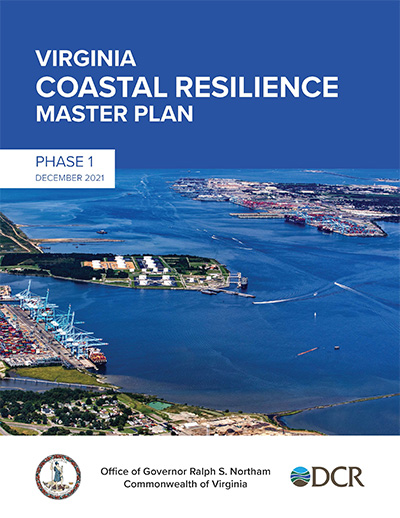
The Commonwealth of Virginia released The Virginia Coastal Resilience Master Plan (CRMP) Phase I in December 2021.
This first phase of Virginia Coastal Resilience Master Plan is a call to action for the Commonwealth. From growing cities to migrating coastal wetlands, Virginia’s coast faces a new reality. This Plan shows that without action, rising sea levels and increasingly severe weather from climate change threaten our cherished coastal regions’ economic, cultural, and environmental resources.
The Master Plan builds on the 2020 Virginia Coastal Resilience Master Planning Framework, which outlined the goals and principles of the Commonwealth’s statewide coastal resilience strategy. Recognizing the urgent challenge flooding already poses, the Commonwealth developed Phase I of the Master Plan on an accelerated timeline and focused this first assessment on the impacts of tidal and storm surge coastal flooding on coastal Virginia.
The Master Plan leveraged the combined efforts of more than two thousand stakeholders, subject matter experts, and government personnel. We centered the development of this plan around three core components:
Key accomplishments of this first phase of the Master Plan include the following:
The Technical Study examines nine coastal flood events representing varying magnitudes that can be compared over time horizons: 2020 (baseline conditions), 2040, 2060 and 2080. Due to the time available to complete Phase I, the Technical Study does not examine existing or future flood hazards for riverine, stormwater, and compound flooding as affected by sea level rise, nor does it consider how climate change may affect precipitation trends and flooding hazards.
As sea levels rise, flood hazards grow worse in two important ways: floodplains will expand, and floodwaters will deepen. The area of land exposed to coastal flooding will gradually grow in response to sea level rise, and the types of coastal flood impacts that are considered “rare” and “extreme” today will become more frequent and even commonplace in the future.
Projected impacts due to coastal flooding were mapped to identify geographic hotspots that face acute flood risks. Identifying these hotspots allows the Commonwealth to highlight areas that may require additional support to plan for resilience or implement resilience projects.
Notable Findings Between 2020 and 2080:
Over the course of the plan’s development, we learned how essential this work is and how much more there is to do.
Moving forward, we must go beyond determining how flood hazards will change. We must use this information to start honest and productive conversations on how to reduce impacts to communities, critical infrastructure, and natural systems through adaptation, protection, and relocation measures at the community, locality and regional scales.
The Commonwealth, in cooperation with the regional and local entities, compiled an inventory of more than 500 projects and initiatives employing a range of strategies to increase resilience. Of these, 140 resilience projects related specifically to coastal flood hazards, but these projects are just a small portion of the overall needs for the Commonwealth.
Achieving a resilient coastal Virginia will require more resources than currently exist. We know the total cost for making coastal Virginia resilient to sea level rise and other coastal hazards has yet to be quantified, but we do know it is well into the billions of dollars. Yet, the cost of doing nothing is increasingly expensive and not an option to protect and adapt coastal Virginia's social, economic and natural assets.
The Commonwealth has established the Community Flood Preparedness Fund (CFPF) as the primary state-level funding mechanism for coastal resilience project development. Managed by the Department of Conservation and Recreation, this statewide program fills pressing needs by prioritizing low-income communities and provides a permanent and dedicated funding stream to finance flood resilience project development, related studies and capacity building initiatives. Learn more about the CFPF.
Plan document available as a PDF to download/view.