Department of Conservation and Recreation
Conserve. Protect. Enjoy.
Department of Conservation and Recreation



Low-head dams, sometimes called weirs or run-of-the-river dams, are impounding structures built to control water flow, supply water or support historic mills. While the water upstream of the dam may appear tranquil and harmless, these dams create powerful recirculating currents known as a “spin cycle” that can trap even the strongest swimmers wearing a floatation device. Once caught in a spin cycle, it is almost impossible to escape.
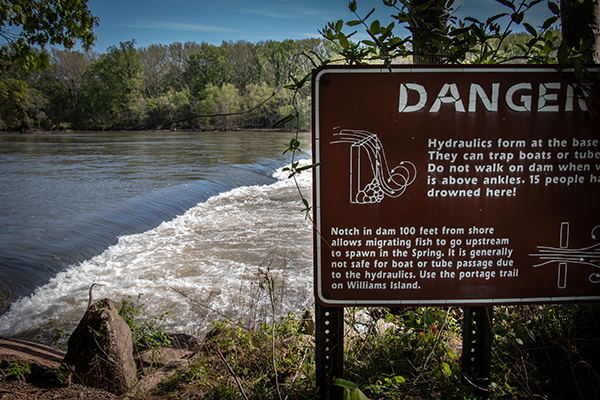
Nearly 800 fatalities have been recorded at low-head dams in the U.S., according to the Low Head Dam Fatalities Database.
Virginia is home to 154 low-head dams, according to the National Inventory of Dams Low-Head Dam Inventory. Launched in October 2025 by the U.S. Army Corps of Engineers, the inventory features an interactive map with information on low-head dams in the U.S., including their location, the size of the dam and if there was previously a fatality. The inventory also features educational information about low-head dams.
If you think you spot a low-head dam, it is crucial that you do these 3 things:
You can take the following steps to protect yourself:
In cooperation with Virginia Department of Wildlife Resources, we urge everyone to stay safe by avoiding low-head dams while enjoying rivers and streams.
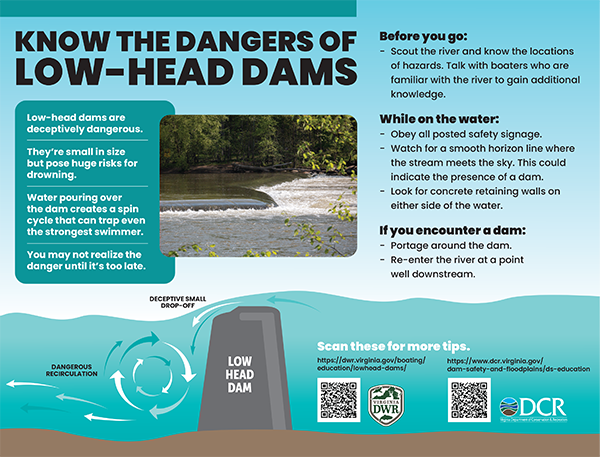
Find more safety tips at https://dwr.virginia.gov/boating/education/lowhead-dams/